Last reviewed:
Live Dealer BlackjackHow It Works, Table Formats and Rules to Check
Use this guide to identify the exact live-blackjack format before relying on a strategy chart. Start by confirming whether the result is physically dealt or RNG-led, then read the payout, dealer rule, special rules, timer and round-history controls.
A live video stream, famous provider or VIP label does not prove better odds, operator quality, legal access or reliable withdrawals.
Classic, Infinite, Speed, Free Bet, Power, Lightning, VIP or RNG-style.
3:2 or 6:5, S17 or H17, doubles, splits, surrender and special rules.
Exact title, provider label, rules screen, accepted wager, round ID and history.
Rushed clicks, automatic rebet, rising side-bet exposure or loss chasing.
Written by Michael Johnson. Live-blackjack formats, rules and source evidence reviewed by Sarah Roberts. Research process: How we test. Editorial standards: Editorial policy.
How does live dealer blackjack work?
Live dealer blackjack uses physical cards dealt by a human on a video stream, while the online interface accepts bets, displays decisions and records settlement. The base objective is standard blackjack, but the table experience can change through seven-seat, unlimited-seat, speed, Free Bet, Power, multiplier, VIP and RNG-style formats. Before joining, verify the exact payout, dealer rule, split and double terms, timer, side bets and result history. A live stream does not prove better odds, operator quality or legal access.
Page boundary: this educational guide contains no live-table link, casino signup, deposit link, bonus claim or operator affiliate button.
Live Blackjack in 90 Seconds
| Question | Direct answer | What to check | Main boundary |
|---|---|---|---|
| What is live dealer blackjack? | Blackjack dealt with physical cards by a human dealer and viewed through a live video stream. | Exact title, provider, studio or room label and whether the table identifies itself as Live. | A live presentation does not prove operator quality. |
| What determines the game result? | The physical card deal determines the hand; OCR and the platform convert and record that result. | Accepted wager, visible cards, round ID, settlement and game history. | The video image alone is not the complete platform record. |
| Is every blackjack game in a Live lobby physically dealt? | No. First Person Blackjack, Blackjack VZN and Blackjack X are current RNG or live-style examples. | Live, RNG, First Person, VZN, X, automated or hybrid labels. | A table-style interface or chat does not make the result physically dealt. |
| What is the best starting format? | A standard seven-seat table with clearly displayed rules and an accessible Help panel. | 3:2 or 6:5, S17 or H17, double, split, surrender, side bets and timer. | A better rules label does not guarantee a winning session. |
| Which rules matter most? | Outcome source, blackjack payout, dealer soft-17 rule, peek / hole-card rule, decks, doubles, splits, surrender, special rules and side bets. | The current table's Rules, Help, Paytable and Bet Limits panels. | A ruleset from another table may not apply. |
| What does Infinite or scalable blackjack mean? | It removes the normal seat cap so many users can make individual decisions in the same round. | Shared / individual starting hand, side bets, Six Card Charlie, timer and limits. | Scalable seating does not reduce gambling risk. |
| What should I do if the stream freezes? | Stop placing new wagers and check accepted-bet status, round ID, balance and game history. | Whether the wager was accepted before betting closed and how the round settled. | A frozen video does not prove that the physical round stopped. |
| What does live blackjack not prove? | It does not prove better odds, legal access, operator reliability, KYC approval or withdrawal quality. | State, licensed operator, account terms, cashier records and support route. | Provider evidence is not operator-account evidence. |
Which live blackjack format should you inspect first?
Use the format name as a starting point, then read the exact table rules. Products with similar labels can use different rules, seats or settlement details.
| Format | Representative examples | Practical conclusion | What changes | Check first | Main tradeoff |
|---|---|---|---|---|---|
| Classic seven-seat live blackjack | Evolution Classic Live Blackjack; standard provider / network blackjack tables. | Best starting format. | Limited physical seats; Bet Behind may be offered when seats are full. | Payout, S17 / H17, decks, peek rule, double, split, surrender, timer and side bets. | Seat waiting and optional side-bet prompts. |
| Infinite or scalable live blackjack | Evolution Infinite Blackjack; Pragmatic Play ONE Blackjack; Playtech All Bets Blackjack. | Best when seat availability is the problem. | The normal seat cap is removed; starting-hand structure and special rules vary. | Shared / individual hand structure, Six Card Charlie, side bets, limits and decision timer. | More participation does not mean simpler rules or lower risk. |
| Speed blackjack | Evolution Speed Blackjack; Pragmatic Play Speed Blackjack. | Not the default for a user still learning decisions. | Simultaneous decisions, quicker dealing, auto-decisions or shorter waiting. | Decision window, auto-hit / stand behavior, Deal Now controls and total hands per session. | Compressed decisions and faster loss exposure. |
| Free Bet blackjack | Evolution Free Bet Blackjack; Pragmatic Play Free Bet Blackjack. | A special-rules product, not free play. | Qualifying doubles or splits may use a free-bet mechanism; settlement rules can change. | Qualifying hands, returned-stake treatment, Push on 22, DDAS and side bets. | The word “free” can hide rule changes and added exposure. |
| Power or modified-deck blackjack | Evolution Power Blackjack. | A standard chart is unsafe until the modified rules are checked. | Expanded double / triple / quadruple options and a shoe with 9s and 10s removed while picture cards remain. | Deck composition, expanded wager actions, split rules, special rules and total exposure. | Familiar presentation with materially different card composition and stake growth. |
| Lightning or multiplier blackjack | Evolution Lightning Blackjack. | Multiplier entertainment, not standard blackjack math. | RNG-selected Lightning Card multipliers are layered onto a physically dealt live hand, with a separate Lightning fee. | Fee, eligible score, multiplier range, next-round treatment, base payout and RTP / version. | Extra cost and multiplier anticipation can extend sessions. |
| VIP, private or dedicated blackjack | Evolution VIP / Salon Privé; Pragmatic Play Privé; operator-dedicated tables. | Presentation and service choice, not a better-odds category. | Higher minimums, private styling, dedicated branding or extra table controls. | Minimum / maximum stake, payout, dealer rules, table speed and account requirements. | Higher limits can increase losses quickly. |
| RNG or live-style blackjack | Evolution First Person Blackjack; Playtech Blackjack VZN; Pragmatic Play Blackjack X. | Not physically dealt live blackjack. | Software RNG generates the result; chat, multiple views or table-style presentation may remain. | RNG label, version, RTP, rules, multiplayer structure and any separate Go Live route. | Live-style presentation can obscure the actual outcome source. |
When provider wording and table rules conflict
Power Blackjack has conflicting Six Card Charlie wording
The current Evolution Live Blackjack page gives two different Six Card Charlie signals for Power Blackjack: one part says the format has no Six Card Charlie, while a later feature section says Power Blackjack includes Six Card Charlie.
How to read it: use the active table's current Help or Rules screen as the final source for that session.
Useful record: exact game title, provider, operator, rules-screen wording and review date.
How a live blackjack round works
- 1
Identify the exact table
Record the title, provider, studio or dedicated-room label and whether the outcome source is Live or RNG.
- 2
Open Rules, Help and Bet Limits
Read the payout, dealer rule, double / split / surrender rules, special rules, side bets, limits and timer before wagering.
- 3
Place the complete wager
Separate the main bet from side bets, fees or Bet Behind exposure and confirm the total amount at risk.
- 4
Confirm accepted-bet status
The betting timer closes and the platform should show whether each wager was accepted before dealing begins.
- 5
Physical cards are dealt and read
The dealer handles the cards; OCR and the game system translate the visible card result into platform data.
- 6
Player decisions are submitted
Hit, stand, double, split, surrender or special actions appear according to the table's rules and timer.
- 7
The dealer completes the hand
The dealer follows the posted drawing rule; the platform settles the main wager, side bets and any product-specific feature.
- 8
Game history becomes the record
Check round ID, accepted wagers, visible result, settlement and balance. If anything is unclear, stop new wagers and save the record before contacting support.
The 10 table labels that change the game
The exact live table owns these labels. A similar provider title can use a different payout, dealer rule, timer, side-bet menu or settlement setup.
| Label or record | Exact question | Why it matters | Controlling evidence | Common mistake |
|---|---|---|---|---|
| Outcome source | Is the game Live, RNG, First Person, VZN, X, automated or hybrid? | It identifies whether physical cards or software generate the result. | Exact title, lobby label and Help screen. | Treating a Live-lobby location as proof of physical dealing. |
| Blackjack payout | Does a natural pay 3:2, 6:5, 1:1 or another amount? | The payout changes the value of a natural blackjack. | Current Rules / Paytable screen. | Treating one provider page as the payout for every table. |
| Dealer soft 17 | Does the dealer stand or hit on soft 17? | S17 / H17 changes dealer behavior and strategy assumptions. | Current table rule wording. | Assuming a familiar title uses the same dealer rule elsewhere. |
| Hole card and peek | Does the dealer receive / check a hole card before player actions? | It can change exposure when doubling or splitting against a possible dealer blackjack. | Current Rules / Help screen. | Treating American and European dealing procedures as identical. |
| Deck and shuffle model | How many decks are used, and when is the shoe reshuffled? | Deck composition and shuffle procedures affect the applicable rule model. | Current table Help screen and visible shoe procedure. | Assuming every live table uses a standard eight-deck shoe. |
| Double and DDAS | Which totals can double, and is double after split allowed? | It changes available actions and total stake exposure. | Current Rules screen. | Treating a displayed double button as permission for every double. |
| Split and split aces | Which pairs can split, can they resplit, and what happens to split aces? | Splits create additional hands and additional wager exposure. | Current Rules screen. | Treating a split 21 as a natural blackjack payout. |
| Surrender | Is surrender available, and is it early or late? | Availability depends on the dealer-check and table procedure. | Current Rules screen and action controls. | Assuming every weak hand can surrender. |
| Side bets and special rules | Which side bets, Six Card Charlie, Push 22, free actions, modified cards, fees or multipliers apply? | These features can change settlement, cost and volatility. | Current Rules, Paytable and total-stake display. | Treating a similarly named variant as the same special-rule setup. |
| Timer, rebet and game history | How long is the decision window, what does Rebet repeat, and where are accepted wagers and round IDs stored? | These controls determine decision pressure and the evidence available after an interruption. | Live interface, accepted-bet state and game history. | Treating a frozen stream as proof that an accepted wager was cancelled. |
Three common live-blackjack situations
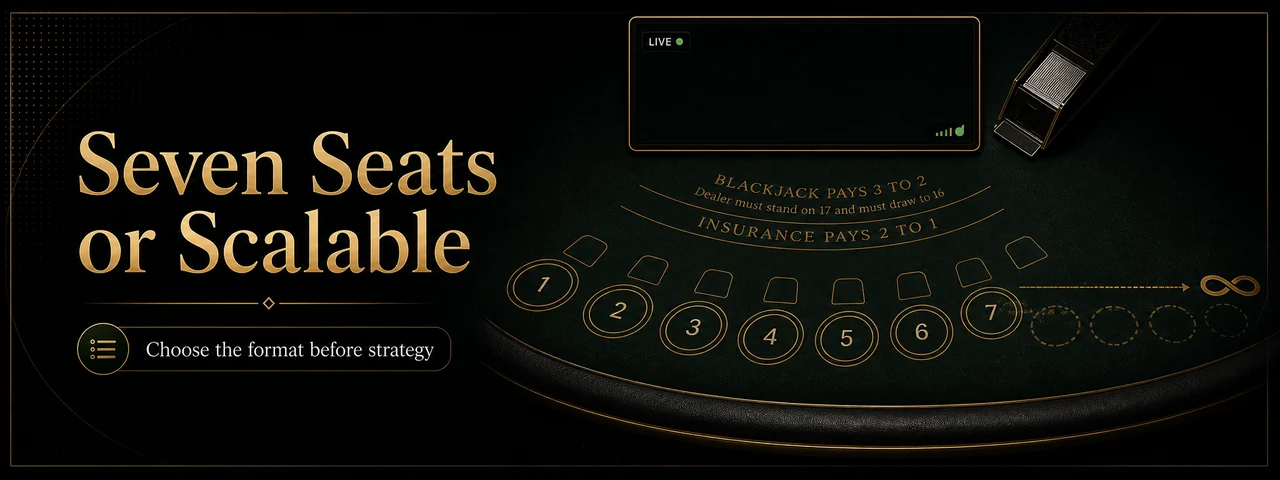
The seven-seat table is full
Available choices: wait for a seat, use Bet Behind where offered, or open an Infinite / scalable table.
Best default: choose the scalable table only after checking its hand structure, side bets and special rules.
Common mistake: that Bet Behind is a practice mode or that unlimited seats lower risk.
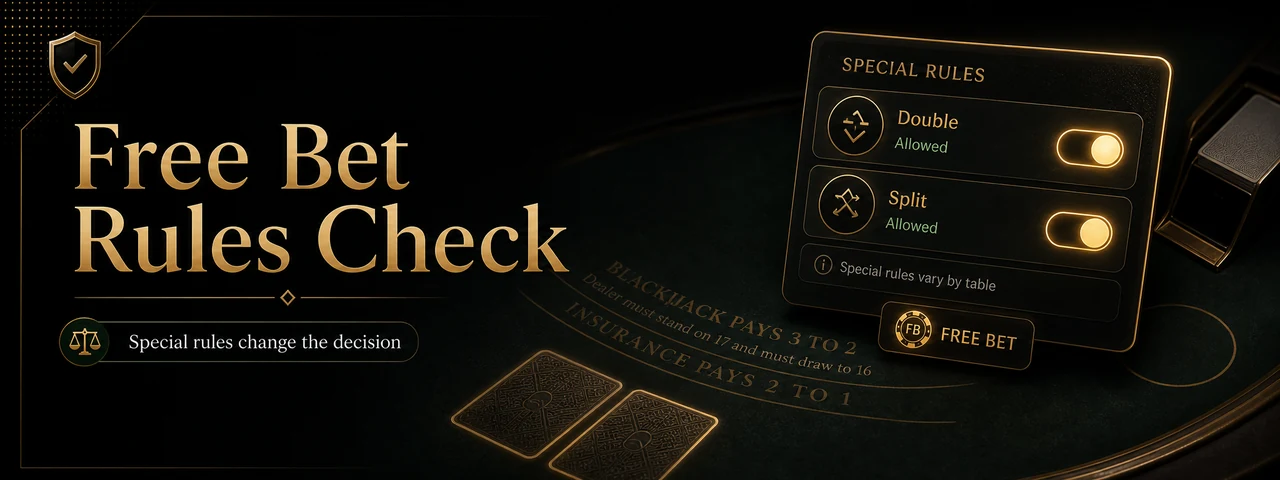
The title says “Free Bet Blackjack”
What “free” can mean: the product may place a qualifying double or split amount without changing the original main bet.
What to verify: qualifying hands, Push on 22, DDAS, returned-stake treatment and side bets.
Common mistake: that the round is free, risk-free or equivalent across providers.
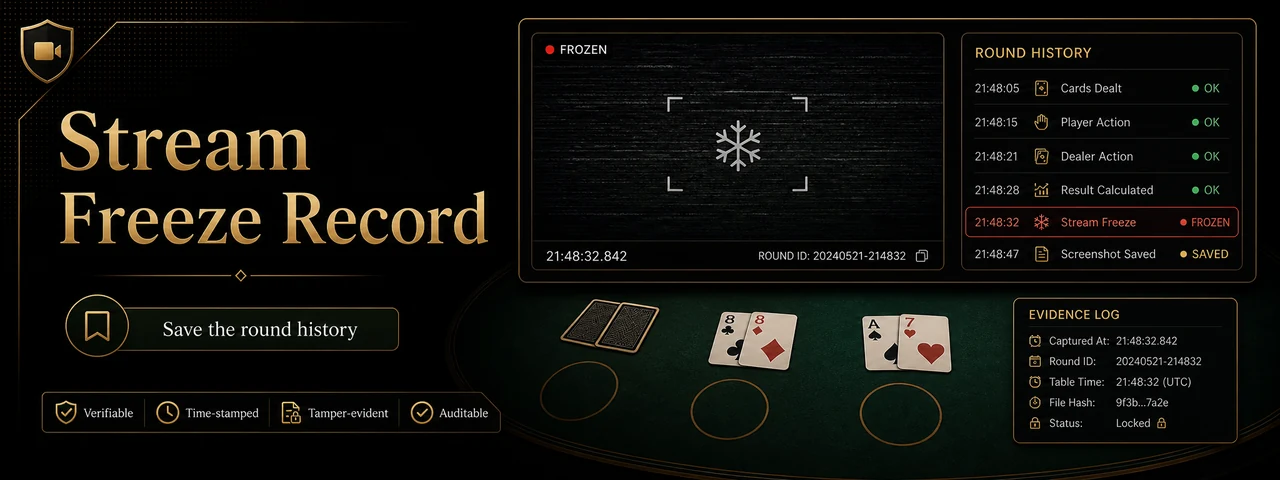
The video freezes after betting closes
First check: accepted-wager status, round ID, balance and game history.
Next step: capture the title, time, wager amount, status wording and support ticket before placing another wager.
Common mistake: that the physical hand or settlement stopped because the video stopped updating.
Official source snapshot
Provider sources support product identity and format facts. They are first-party sources and cannot independently prove operator quality or every-title availability. The exact live table and operator records remain controlling for the user's session.
| Source | Owner | Checked | What it supports | What it does not prove | Safest use |
|---|---|---|---|---|---|
| Evolution Live Blackjack Portfolio | Evolution | July 15, 2026 | classic seven-seat, Bet Behind, Infinite, Free Bet, Power, Lightning, VIP, Salon Privé, First Person and representative side / special features | current access through one operator, one universal ruleset or operator quality | current Evolution format examples and table-rule conflict checks |
| Playtech Live Current Product Overview | Playtech | July 15, 2026 | current Live product scope, Blackjack VZN as RNG without live dealers or physical cards, and other Playtech live-style examples | every-title U.S. availability, operator quality or active RTP / version | live-versus-RNG format boundary |
| Playtech USA Locations | Playtech | July 15, 2026 | representative U.S. live-studio and All Bets Blackjack context | personal state access, every operator or every-title availability | representative scalable-live example |
| Pragmatic Play ONE Blackjack Original Product Evidence | Pragmatic Play | July 15, 2026 | unlimited-player format, representative side bets and Six Card Charlie product context | current availability through one operator or unchanged active rules | original scalable-format evidence |
| Pragmatic Play Free Bet Blackjack | Pragmatic Play | July 15, 2026 | 2026 Free Bet qualification, DDAS context, Push on 22 and representative side bets | that every provider's Free Bet product uses identical rules | current product-specific Free Bet example |
| Pragmatic Play Speed Games | Pragmatic Play | July 15, 2026 | seven-seat Speed Blackjack, simultaneous decisions, auto-decisions and faster handling | one universal timer, ruleset or state availability | speed-format and decision-pressure example |
| Pragmatic Play Blackjack X | Pragmatic Play | July 15, 2026 | Blackjack X as a blackjack variant without a live dealer, with multiplayer / chat presentation | physical dealing or live-studio outcome generation | RNG / live-style boundary |
| GLI Live Dealer Gaming Test and Evaluation | Gaming Laboratories International | July 15, 2026 | physical dealer, live stream, player interface, OCR / result data, remote-interface testing and on-site studio inspection | certification of every table or a particular user outcome | technical workflow and testing boundaries |
| Exact Current Table Rules / Help / Bet Limits | Current game / provider / operator interface | Per table | active payout, dealer rule, deck, double, split, surrender, side bets, limits, timer and special rules | future rules or another table's configuration | controlling table-rule evidence |
| Exact Current Game History / Round Record | Current operator / platform | Per disputed round | accepted wager, round ID, settlement, balance change and recorded result | why an operator made a later account or withdrawal decision | stream-interruption and settlement review |
| Current Licensed Operator Lobby and State Label | Licensed operator / platform | Before access | current state access, enabled title and provider label for that account | every state, every operator or permanent availability | personal availability check |
| National Problem Gambling Helpline | National Council on Problem Gambling | July 15, 2026 | call / text 1-800-MY-RESET, chat and 24 / 7 / 365 support routing | game, provider, operator, legal or payout status | gambling-harm support and NCPG chat |
What live blackjack does not prove
- A live video stream
- Does not prove better odds, legal access, operator licensing or withdrawal reliability.
- A well-known provider
- Does not control the user's registration, KYC, deposits, withdrawals, support or complaint handling.
- A 3:2 payout label
- Does not make the table safe, profitable or suitable for a particular budget.
- Infinite or unlimited seating
- Does not reduce variance, cost or gambling-harm risk.
- A “Free Bet” title
- Does not mean free play, zero exposure or standard blackjack settlement.
- A VIP or private room
- Does not prove better rules, better RTP or better account treatment.
- A Lightning multiplier
- Does not show probability, expected value, proximity or that a multiplier is due.
- Dealer chat, streaks or game history
- Cannot predict the next physically dealt or RNG-generated result.
When to stop a live-blackjack session
- The timer makes you click before the decision is clear.Skip the hand or leave the table instead of relying on a rushed guess.
- Rebet repeats side bets, fees or a larger stake automatically.Clear the wager and rebuild it only if it still fits the pre-set entertainment limit.
- Side bets have become part of every hand without a fresh decision.Remove them and review the complete per-round exposure.
- You move to Speed, VIP or a higher-limit table after a loss.Changing presentation or pace does not recover a previous result.
- You switch providers, dealers or rooms because a win feels due.A new table does not reset card-order or gambling risk.
- Free Bet or Lightning features feel like a recovery opportunity.Special features change rules or cost; they cannot erase previous losses.
- A frozen stream creates urgency to place another wager.Stop and check accepted-bet status, round ID, balance and history first.
- Debt, secrecy, stress, urgency or loss chasing appears.Call or text 1-800-MY-RESET or use NCPG chat.
For gambling-related support, call or text 1-800-MY-RESET, or use NCPG chat.
Go deeper only after checking the table
Use the route that owns the exact follow-up question. These links are educational and are not casino-operator recommendations.
| Follow-up question | Use this page | Why | Boundary |
|---|---|---|---|
| I need complete blackjack rules and card values | Blackjack rules | Owns objective, card values, player actions, dealer flow and settlement. | Rules knowledge does not guarantee a result. |
| I need hit, stand, double and split decisions | Basic blackjack strategy | Owns the rule-dependent decision chart. | The chart needs to match the exact table. |
| I need S17, H17, peek and hole-card detail | Blackjack dealer rules | Owns complete dealer-procedure analysis. | Dealer rules cannot predict one hand. |
| I need 3:2, 6:5 and house-edge math | Blackjack odds and house edge | Owns rule-factor and expected-value analysis. | Long-run math does not predict a short session. |
| I need Perfect Pairs, 21+3, Hot 3 or Bust It | Blackjack side bets | Owns paytables, exposure and side-bet boundaries. | Side bets cannot protect the main hand. |
| I need insurance or even-money analysis | Blackjack insurance | Owns the separate wager and break-even math. | Insurance is not loss protection. |
| I need phone, app or touch-control checks | Mobile blackjack | Owns device, app / browser, data, battery and control checks. | Mobile convenience is not safer play. |
| I need the complete studio, stream and OCR lifecycle | How live dealer games work | Owns broad technical delivery and settlement architecture. | Technology does not guarantee operator quality. |
| I need timer, chat, etiquette and rebet guidance | Live dealer tips | Owns practical live-table behavior. | Tips cannot change odds. |
| Live play is becoming hard to stop | Responsible gambling | Owns limits, cooling-off, self-exclusion and support routes. | Use before pressure escalates. |
Live Blackjack FAQ
What is live dealer blackjack?
Live dealer blackjack uses physical cards handled by a human dealer and shown through a video stream, while the online interface accepts bets, displays actions and records settlement.
Is live dealer blackjack played with real cards?
Standard live dealer blackjack uses physical cards and a human dealer. The cards are read into the platform through the game system, commonly using OCR or related result-capture technology.
Is live dealer blackjack the same as RNG blackjack?
No. Standard live blackjack uses a physical deal, while RNG blackjack uses software to generate the result. First Person Blackjack, Blackjack VZN and Blackjack X are live-style or multiplayer examples that are not physically dealt by a live dealer.
What rules should I check before joining a live blackjack table?
Check the outcome source, blackjack payout, S17/H17 rule, peek or hole-card procedure, deck and shuffle model, double and split rules, surrender, side bets, special rules, limits, timer and game-history access.
What is Infinite or scalable blackjack?
Infinite or scalable blackjack removes the normal physical-seat cap so many users can participate in the same round. The shared-hand structure, side bets, special rules, limits and timer still vary by product.
What is Bet Behind in live blackjack?
Bet Behind lets a user place a wager linked to a seated player's hand where the table supports it. It is a separate real-money wager, not a practice mode or lower-risk substitute for taking a seat.
What is Speed Blackjack?
Speed Blackjack shortens waiting by using simultaneous decisions, faster dealing, Deal Now controls or auto-decisions. The quicker pace can increase decision pressure and the number of hands completed in one session.
What is Free Bet Blackjack?
Free Bet Blackjack uses product-specific mechanisms that can fund qualifying doubles or splits without increasing the original main bet. It can also use changed dealer-settlement rules such as Push on 22, so the exact version needs a rules-screen check before play.
What is Power Blackjack?
Power Blackjack is a modified-deck format with expanded doubling options. Evolution's current page describes eight decks with 9s and 10s removed while picture cards remain, so a standard blackjack chart should not be assumed to apply.
What is Lightning Blackjack?
Lightning Blackjack combines a physically dealt live hand with RNG-selected card multipliers and a separate Lightning fee. It is not standard blackjack math, and the current fee, multiplier, payout and RTP version need a rules-screen check.
Are VIP live blackjack tables better?
VIP and private tables can offer higher limits, dedicated presentation or extra table controls, but the label does not prove better payouts, better odds, safer play or better account treatment.
What happens if the live blackjack stream freezes?
Stop placing new wagers and check whether the bet was accepted, then review the round ID, balance and game history. A frozen video does not necessarily mean the physical round or settlement stopped.
Does basic strategy guarantee profit in live blackjack?
No. A matching basic-strategy chart can reduce rule-based decision errors, but it cannot control card order, remove variance, guarantee profit or make higher stakes safer.
Does a live-blackjack provider control KYC, withdrawals or U.S. access?
No. The provider supplies the game or studio technology. The operator or account platform controls state access, registration, geolocation, KYC, cashier activity, withdrawals, support and complaints.
Update notes
- : Rebuilt the page around a completed live-blackjack answer; added a format recommendation, physical-versus-RNG distinctions, eight current format conclusions, a source-conflict resolution, full round workflow, exact rule and record checks, worked situations, current sources, visible FAQ and clean schema.
- : Published the original live dealer blackjack guide.